Skip to main content
Skip to main navigation menu
Skip to site footer
Open Menu
Pedagogika
Home
Current
Archives
Artificial Intelligence
For the use of artificial intelligence in the journal "Pedagogy"
Guidelines for AI Usage in Universities
Ethics
About
About the Journal
Privacy Statement
Copyright notice
Peer-Review
Submissions
Editorial Team
Contact
Search
Register
Login
Home
/
Archives
/
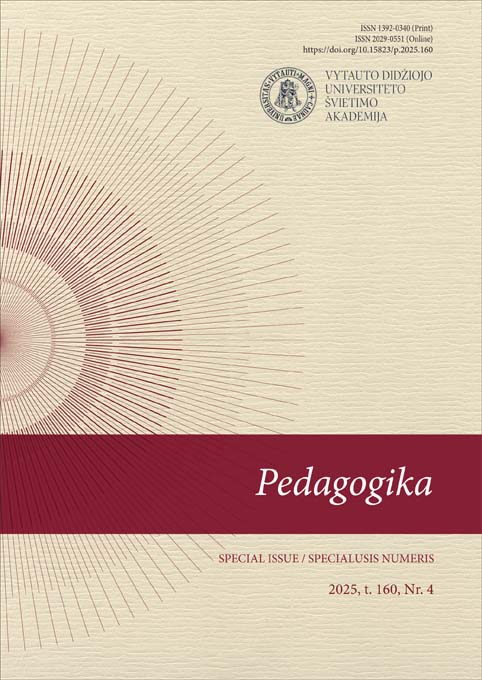
Vol. 160 No. 4 (2025): Pedagogy
Vol. 160 No. 4 (2025): Pedagogy
DOI:
https://doi.org/10.15823/p.2025.160
Published:
2026-03-18
Front Matter
Editorial Board, Table of Contents and General Requirements for Publications
Articles
Overcoming barriers through games: innovative language teaching in inclusive classrooms
Mustafa Yeniasır, Tülay Kaya Tekman
5–22
PDF
AI-assisted vs. teacher-based assessment of EFL students’ writing: a comparative study
İbrahim Tekman, Tülay Kaya Tekman
23–39
PDF
The relationship between preschool teachers’ professional self-efficacy and attitudes towards artificial intelligence
Yakup Yıldırım, Ece Arzum Güçlü
40–73
PDF
Deepfakes and digital violence in adolescent couples: perceptions, risks, and prevention strategies
Rachida Dalouh Ounia, Encarnación Soriano Ayala, Verónica Caballero Cala
74–93
PDF
Consequences of the use of emerging artificial intelligence technologies on adolescents' emotional well-being and adult mediation: a quantitative study
Antonio José González-Jiménez
94–109
PDF
The contribution of the AI-powered Audemy platform to the musical skills of visually impaired individuals
Tuğçe Kaynak Akçaoğlu
110–138
PDF
Challenges posed by artificial intelligence to the learning habits of vocational secondary school students
Juris Straume, Inta Kulberga, Pāvels Jurs, Lāsma Ulmane-Ozolina, Daiva Malinauskienė
139–153
PDF
The relationship between pre-service teachers’ digital technology competencies and their attitudes towards artificial intelligence
Osman Titrek, Nermin Dingin, Cemile Yaşa
154–173
PDF
Exploring ethical criticism and AI applications in literature education through TAM, TPCK, and AI tools
Mirzana Pašić Kodrić, Seniha Krasniqi
174–193
PDF
Barriers to inclusive early childhood intervention in Latvia: insights from professionals and families
Andra Rektina
194–215
PDF
Towards a sustainable urban environment: teacher competences and artificial intelligence to strengthen civic engagement in future generations
Pāvels Jurs, Ilze Judrupa, Solvita Lodiņa, Osman Titrek, Madara Lapsa
216–241
PDF
A research on the effect of organizational belonging perceptions on dimensions of intrapreneurship levels
Gülfer Büyüktaş Gayır, Şehmus Demir, Mustafa Bulut, Zübeyir Özçelik, Sadık Serçek
242–278
PDF
Teachers' opinions on the eTwinning portal (Sakarya province example)
Ahmet Sakin
279–303
PDF
Pedagogical use of artificial intelligence in early education: opportunities, challenges, and solutions
Eva Cipi, Eljona Zanaj, Edvina Cipi
304–323
PDF
Investigation of academicians’ athlete identity and social media addiction levels
Hamdullah Ateş, Gülseren Özaltaş Serçek
324–339
PDF
Examining the exercise addiction and social media addiction levels of physical education teachers
Nurdan Ateş, Gülseren Özaltaş Serçek
340–357
PDF
Attitudes of administrators and teachers working in preschool education institutions toward artificial intelligence (AI)
Arzu Yorulmaz, Turan Çakır
358–383
PDF
Examining the narcissistic personality traits and self-efficacy levels of football coaches according to their artificial intelligence usage situations
Onur Akyüz, Gülseren Özaltaş Serçek
384–407
PDF
Determinants of university students' attitudes toward artificial intelligence: a study on demographic variables, usage habits, and levels
Erdal Buyukbicakci
408–441
PDF
Three levels of challenges during doctoral studies in higher education: personal, institutional, and supervisor-related
Vilma Žydžiūnaitė, Monika Kelpšienė, Monika Šimkutė-Bukantė, Marius Daugėla, Julija Grigėnaitė
442–467
PDF
vmu
open
cris
DOAJ
scopus
ErihPlus
ccinfo
Information
For Readers
For Authors
For Librarians
Language
English
lietuvių