EDITORIAL
Keywords:
editorial, sustainable multilingualismAbstract
Dear Sustainable Multilingualism community,
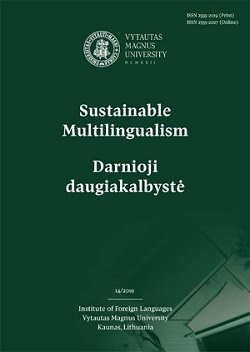
Welcome to the 28th issue of the journal. We launch this issue at a time of profound contradictions in language education. Although multilingualism has become a structural part of today’s life and the importance of plurilingual competence for global success has been acknowledged worldwide, language education continues favoring monolingual language teaching approaches and regional, minority, and immigrant languages continue facing systematic marginalization, posing challenges to both, learners and educators.
The issue features contributions from 21 authors, drawing from their research contexts in the Czech Republic, Germany, Hungary, Indonesia, Lithuania, Spain, South Africa, Poland, and Ukraine. This broad international representation of the authors highlights the global resonance of contemporary challenges in multilingualism indicating that the tensions are not isolated but rather global imperatives.
Language policy and symbolic power section features two studies dedicated to the theme, each offering new insights that challenge conventional practices. Fabienne Korb and Claudia Polzin-Haumann discuss language policy implementation in Saarland, Germany, focusing on the role of Applied Linguistics for knowledge transfer, which, according to the authors, “can raise awareness of the societal value of multilingualism, especially in contexts marked by linguistic diversity and cross-border interaction”. The study by Alexander Andrason and Admire Phiri, created within the EU Horizon 2020 program project “Multilingual worlds – neglected histories. Uncovering their emergence, continuity and loss in past and present societies” analyses the physical, functional, and multilingual characteristics of the signage in the Tjwa area, namely, the visibility of the nearly extinct African language Tjwao of Zimbabwe in its linguistic landscape.
Multilingual and multicultural classrooms present challenges to language learners and teachers; therefore, the studies of how students perceive learning under different conditions and how teachers manage such classrooms are highly salient today. Lasito and Christine Manara approach this issue by examining students’ perceptions of their own and teachers’ translanguaging practices, namely, the use of their home language Bahasa Indonesia as part of their English as a foreign language learning process. Both educators and learners acknowledge the effectiveness of using the home language “in improving understanding and engagement.” Lilis Afifah, Pratomo Widodo, and Teguh Setiawan explore how multilingual background influences the process of learning German as an additional language focusing on “the role of career-oriented motivation in sustaining student engagement” in a foreign language class.
Mediation in a foreign language learning process has been recognized as a significant communicative activity, thus, research into the use of mediation carries significant theoretical and practical implications. The issue presents a classroom-based study by Nikola Popperová and Silvie Převrátilová that highlights how CEFR-aligned mediation tasks employed into Czech-as-a-second-language university course for incoming students can efficiently utilize “learners’ full linguistic repertoires in classroom interaction even at lower proficiency levels”. Anna Szczesniak and Iwona Gryz investigate bilingual education in Poland’s primary and secondary schools, highlighting the importance of improving teacher-training programs, textbook design, unequal learner English language competences and provide important insights into CLIL practices.
Language teacher attitudes and experiences in promoting individual plurilingual and pluricultural awareness and the use of specific multilingual teaching practices are discussed by Babušytė Diana and Miroslav Stasilo, who present the study conducted with German and French as foreign language teachers in Lithuanian schools in 2023–2025. Tetiana Hunko focuses on the past and present of the eternal debate on native vs non-native language teachers, exploring 53 open-access studies (produced in 2000–2024) on Spanish as foreign language teachers. The researcher highlights the existing research gap in the field and calls for “promoting more diverse and critical approaches” which would allow “to advance toward a more equitable and pluralistic approach to language teaching.”
The articles that appear under the section Language in Context: Discourse and Terminology are deeply rooted in the contemporary global context. Krisztián Váradi, István Csernicskó, and Kornélia Hires-László explore the outcomes of the first year of their research project on building a cross-border educational terminology database. The project is supported by the Hungarian Academy of Sciences and aims at harmonizing the regional varieties of the Hungarian language, translating the country-specific educational terms, and collecting regional dialect expressions related to education. The study investigates the main conceptual differences between the Hungarian and Ukrainian public education systems and addresses the terminological challenges. Language is a living system designed to meet communication needs of its speakers, reflecting human experiences, therefore, bound to evolve and change. When human societies undergo drastic, traumatic changes, such as the ones happening currently in the countries experiencing brutal wars, their languages must change rapidly to reflect and survive the new reality. Therefore, the article by Liliia Kharchuk and Zoriana Kunch, who analyze euphemisms in the Ukrainian military sociolect as semantic, stylistic and pragmatic dimensions of wartime discourse, is timely and of paramount importance. The study identifies that euphemisms have become “a salient feature of the contemporary Ukrainian military sociolect”, reflecting how society reacts to the traumatic reality.
The discussion initiated in this issue of the journal represents only a fraction of vital conversations taking place in our field. To continue this dialogue, we cordially invite you to join us at the international scientific Sustainable Multilingualism conference, hosted by the Institute of Foreign Languages of Vytautas Magnus University (VMU) every two years. The Sustainable Multilingualism 2027 (SM27) conference will be held from June 3 to June 5, 2027, in Kaunas, Lithuania. To learn more about the conference and to register, please, visit our website https://uki.vdu.lt/conferences.
We are also delighted to share the news that the SM27 conference has been officially selected as a featured event during Lithuania’s Presidency of the Council of the European Union. Lithuania will hold its second rotating Presidency of the Council of the EU from January 1 to June 30, 2027. We hope you will join us for this gathering of our Sustainable Multilingualism community.
We are profoundly grateful to the authors whose intellectual contributions fill these pages and to the reviewers whose rigorous feedback and dedication ensure the highest standards of our journal. As we look ahead, we encourage both established and emerging researchers to submit their original work, contributing to the ongoing dialogue and shaping the future of sustainable multilingualism together.
Nemira Mačianskienė
Editor-in-Chief
Downloads
Published
Issue
Section
License
Copyright (c) 2026 Sustainable Multilingualism / Darnioji daugiakalbystė

This work is licensed under a Creative Commons Attribution-NonCommercial 4.0 International License.